SHAPS Test: The Scientific Anhedonia Measurement Tool
Have you ever wondered how a simple online questionnaire can accurately measure something as complex as your capacity for joy? If you are among the millions experiencing emotional numbness or a reduced interest in activities you once loved, you might be asking: "Why does everything feel so gray lately?" Seeking reassurance about a mental health assessment's validity is a natural step in your healing journey.
The feeling of being unable to experience pleasure is known as anhedonia. It is a common symptom of several mental health conditions, but it can also occur on its own. We know how isolating emotional numbness feels—this test meets you where you are. To help people understand this feeling, psychologists developed the SHAPS test. This tool is the foundation of our platform, designed to provide you with clear and immediate insights into your emotional state.
Let’s explore how decades of research created a tool to help you understand emotional numbness. By understanding the science, you can feel more confident when you begin your confidential screening to explore your own emotional health.
Understanding the SHAPS Scale: A Historical Overview
The SHAPS scale did not appear overnight. Years of clinical research produced it, as experts sought a better way to measure a person's ability to feel pleasure. Before this scale, doctors struggled to distinguish general sadness from a specific loss of interest in life and social connections.
From Clinical Research to Global Standard
The SHAPS was first developed in the 1990s by a team of researchers led by RP Snaith. Their goal was to create a tool that was brief, easy to use, and highly accurate. They focused on "state anhedonia," which refers to how a person feels right now compared to their normal self. This was a major breakthrough because it allowed doctors to see changes in a patient's condition over time.
Over the last 30 years, the SHAPS has been translated into dozens of languages and used in thousands of clinical trials. Thousands trust this globally recognized scale to assess anhedonia accurately. Its extensive research background makes it the foundation of our scientifically validated anhedonia screening. Its history of success ensures that the results you receive are grounded in established science.
How SHAPS Compares to Other Anhedonia Assessment Tools
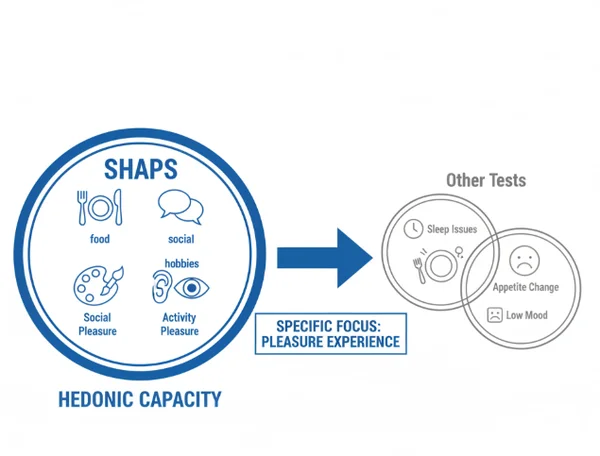
There are other tools used to measure mood, such as the Beck Depression Inventory (BDI). However, the SHAPS is unique because it focuses specifically on the "hedonic capacity," or the ability to experience pleasure. Many other tests mix in symptoms like sleep loss, appetite changes, or suicidal thoughts. While those are important, they can sometimes hide the specific issue of emotional numbness.
The SHAPS avoids these "confounding factors." It asks about your interest in food, social interaction, pastimes, and sensory experiences. This narrow focus makes the SHAPS test more sensitive to the subtle signs of anhedonia that other tests might miss. For those looking for a comprehensive anhedonia assessment, the SHAPS remains the preferred choice for many professionals.
The Science of Measurement: Psychometric Properties of SHAPS
When scientists talk about a "good" test, they look for two main things: reliability and validity. These are the psychometric properties that prove a test actually works. The SHAPS has undergone rigorous testing to ensure it meets these high standards, providing users with trustworthy data.
Reliability and Consistency in Anhedonia Testing
Reliability means that the test produces consistent results. If you take the test today and again tomorrow—assuming your mood hasn't changed—the score should be very similar. Researchers have found that the SHAPS has high "internal consistency." This means that all the questions in the test work together to measure the same core experience.
Furthermore, the SHAPS shows high "test-retest reliability." In clinical studies, patients who took the SHAPS twice in a short period received nearly identical scores. This consistency is vital because it means the tool is measuring a real, stable emotional state rather than a random mood swing. When you start your emotional wellness journey, you can trust that the tool is designed for precision.
Validity: Does SHAPS Actually Measure What It Claims?
Validity is even more important than reliability. It answers the question: "Is this test actually measuring anhedonia, or is it just measuring general sadness?" To prove SHAPS test validity, researchers compared SHAPS scores with deep clinical interviews conducted by psychiatrists. They found a very high correlation between the two.
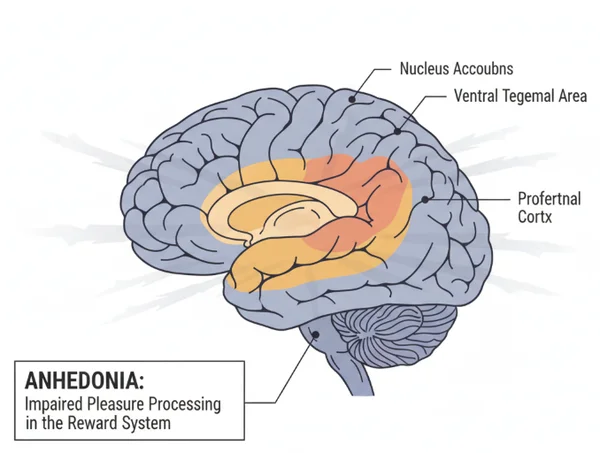
Scientists verified the SHAPS’s ‘discriminant validity.’ Unlike general mood tests, it isolates anhedonia from symptoms like anxiety or physical pain. Because the SHAPS specifically targets the brain’s reward system responses, it is a highly valid way to identify when that system is not functioning at its best. You can explore your emotional health with our test to see how these validated questions provide a clear picture of your well-being.
Interpreting Your Results: Clinical Thresholds and What They Mean
A test is only useful if you understand what the numbers mean. The SHAPS uses a simple scoring system, but the interpretation of those scores is based on decades of data from both healthy individuals and those with clinical depression.
From Score to Symptom: Understanding Anhedonia Severity Levels
The standard SHAPS consists of 14 items. Each item asks if you would enjoy a specific activity, such as "I would enjoy a warm bath or a refreshing shower." You answer whether you agree or disagree. In the clinical version, a score above a certain "threshold" suggests the presence of anhedonia.
We simplify this process for you. Instead of just giving you a raw number, our detailed analysis report explains where you fall on the spectrum:
-
Low Score: Suggests your capacity for joy is largely intact.
-
Moderate Score: May indicate early signs of emotional numbness or burnout.
-
High Score: Suggests significant anhedonia, which may warrant further discussion with a professional.
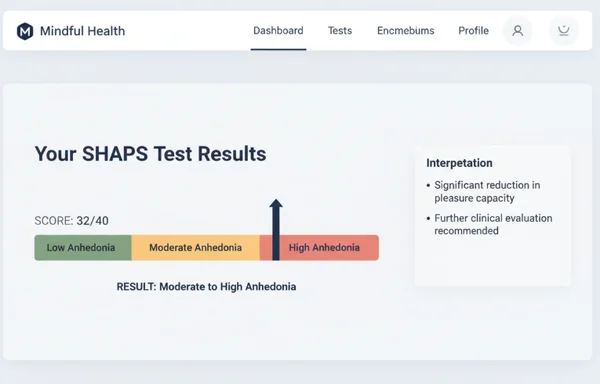
Understanding these severity levels helps you move from feeling "vaguely numb" to having a concrete way to describe your experience.
What Your SHAPS Score Reveals About Your Emotional Experience
Your score is more than just a number; it is a reflection of how your brain is currently processing rewards. Anhedonia is often linked to the dopamine system in the brain. A high score often means your brain’s reward system isn’t responding to previously enjoyable activities.
This revelation can be a huge relief. It helps you realize that you aren't "lazy" or "broken." Instead, you are experiencing a recognized psychological state that has a name and a scientific explanation. By using our scientifically-backed screening, you can gain the vocabulary you need to talk about your feelings with friends, family, or a doctor.
Beyond the Numbers: Using SHAPS Results as a Starting Point for Healing
Your SHAPS results are a launchpad—not a label. They empower you to reclaim joy with clarity. While the numbers are based on rigorous clinical research, they are meant to support you, not to define your future.
Knowing your score allows you to take the first step toward rediscovering joy. Whether it means making lifestyle changes, practicing mindfulness, or seeking professional therapy, you cannot address what you have not yet measured. Understanding the science behind the assessment builds the confidence you need to take your mental health seriously.
If you are ready to move from confusion to clarity, we invite you to take the first step today. It is free, completely anonymous, and based on the gold-standard SHAPS scale. Take a few minutes to check in with yourself and start your journey back toward a life full of color and feeling.
The Takeaway
How do researchers ensure the SHAPS test accurately measures anhedonia?
Researchers use a process called "clinical validation." This involves giving the SHAPS test to thousands of people, including those with diagnosed depression and those without. They then compare the test results to the findings of expert doctors. If the test consistently matches the doctors' expert opinions, it is considered accurate. The SHAPS has passed these tests many times over the last 30 years.
Can a self-report questionnaire like SHAPS really diagnose anhedonia?
It is important to understand that an online test is a screening tool, not a medical diagnosis. A diagnosis requires a face-to-face evaluation by a licensed professional. However, self-report tools like the SHAPS are highly effective at identifying symptoms and patterns. They are often the first step a person takes before speaking with a doctor.
How has technology changed the administration of traditional clinical scales like SHAPS?
In the past, these tests were only available on paper in a doctor's office. Technology has made mental health tools much more accessible. Today, you can take a digital anhedonia test from the privacy of your home. Modern platforms also allow for personalized reports, which can compare your scores to a vast database of information to provide more insight than a paper test ever could.
What should I do after completing my SHAPS assessment?
Once you have your results, the next step is reflection. If your score indicates significant anhedonia, you might consider sharing the report with a counselor or therapist. It can serve as a "conversation starter" to help them understand exactly how you are feeling. You can also look into lifestyle adjustments like "behavioral activation." No matter the score, taking the initiative to check your health is the most important part of the process.